Wednesday, March 23, 2016

Loyalty


      In light of the persistent terrorist attacks on Western countries, it seems a good time to speak up about loyalty. Nowadays you have various technology giants coming down on the side of privacy as opposed to surveillance. The Apple case stands out. But it makes one wonder, where is the loyalty of these companies? Especially since they got their start under our system, in our country, the USA. Could Google, Apple, Amazon or Microsoft have gotten a similar start in a smaller country somewhere, with no national Internet (developed by the government after all) to capitalize on? Perhaps, to some extent. But here in the US they have all become behemoths, making many, many millions. Some of the money they made was undoubtedly through government contracting jobs. 

      And now they want to deny the same government any recourse to obtain records from a terrorist-used Iphone? Because they are worried about privacy precedents? Oh come on. The NSA has already demonstrated their ability to collect huge amounts of information. And commercial companies harvest huge amounts of freely-given personal data. You have people posting all kinds of personal info on social media sites, completely voluntary. And yet a company won't co-operate in the unlocking of one lousy phone, to help authorities catch terrorists. 

So the terrorists laugh at civilization, and keep blowing us up. If Apple and these other companies will not help the government (representative of the people), then their loyalty must be with the terrorists. Or they simply have none. Maybe they should move to Syria.

Now, loyalty is not such a bad thing. During WWII, or even during the World Trade Center bombings, people came together and proclaimed their loyalty as Americans. The flag-waving was epidemic. If there was a cellphone back then that could have helped catch the WTC bombers, would Apple refuse to unlock it? Who made Apple what it is, anyway? American customers! And yet they thumb their nose at American authorities. Maybe Apple should move to Syria, since apparently their loyalty is with ISIL.

A stretch, perhaps? But still these corporations show zero loyalty to the nation that birthed them. It is disgusting. Why can't Apple dispatch a technical team to the justice department, to help them unlock that one phone? That is what a company would have done in the past. But nowadays everything is manufactured overseas anyway. I suspect that Apple would need the help of some South Koreans and Chinese, since they have the true technical know how to get into a phone nowadays.

     This is not to say that companies should have fanatical, slavish loyalty to the government no matter what.  This is a democracy, after all.  But when some terror suspects murder many people, and hide potential information on a company's product, that company should step up and help - period.

Come on, tech giants. Show just a smidgen of loyalty to our country. You were born in the USA, like it or not, and for that you owe some allegiance.

Thanks for reading.

Tuesday, March 22, 2016

Beware the Stalking Predator

There once was a cat named Callie
who got into moods wild and silly...
There once was a plant in my living room,
that Callie chewed before fleeing, vroom!

There once was a feather duster,
minding its own business on the table,
She jumped up and bit down on feathers,
took it and ran as fast as she was able.

There once were birds who flew outside,
Oblivious to the predator fixated inside.
Thereafter, any toy or tool with fur or feathers
got pegged as a bird, ended up in tatters.

Even hands and feet moving of their own volition,
were viewed as prey, slated for kitty demolition.

Now the human (owned) must keep a sharp eye,
lest he get charged and bit, then utter loud cries.

(c) M Wilson 2014 

- end

Monday, March 21, 2016

He Ate My Lunch

(In response to a humorous Facebook post)

What strange manner of creature this,
who pretends sympathetic friendship?
Proclaims steadfast loyal admiration,
promises to subject you to no hardship.

The quick as a wink,
fast as a flash,
the minute you sit down to eat
your lunch meal of Ramen,
he swoops in with a utensil
thrusts his prehensiles,
and gobbles up a whole
HALF of your noontime repast!

The Nerve!
The chutzpah!
The sheer rude Neanderthal crudity!
I mean it is not as if you offered him any...
And you thought he was your friend!

Dump the boy,
leave him to his toys.
Go find yourself a man,
who considers it his duty
to leave your Ramen alone.
Go out with the man with that plan.

But you had better eat lunch at
McDonalds or Burger King.
(Nary a Ramen noodle in sight
at those places, last time I checked. )

Good luck with your love life,
and keep those noodles under lock and key.
While the best things in life often are,
these Ramen noodles are not free!

- end with a smile

New by Dycen Alexander

My good buddy and alter ego dycen has requested that I put up his Amazon Kindle books for sale again.  So here they are, starting with the latest one Epic Prime collections:

Epic Prime Collection – www.amazon.com/dp/B01D8107K0

Experimental Tales – www.amazon.com/dp/B01AWJSRBC

The Osmotics – www.amazon.com/dp/B00IDW1OFM

New Venture – First Contact in the Kuiper Belt – www.amazon.com/dp/B00U9URST2 

Thank you for taking a look on your Kindle-compatible device today!


Thursday, March 17, 2016

Trump-et

That Donald Trump is a riot,
claimingfollowers cannot be subdued;
Anonymous hacked Trump's private info,
including his social security number.

Media circus goes on entertaining us,
exposing new outrages every day.
Vladimir Putin complains about him,
John Kasich eagerly joins the fray.

Foreign leaders try to endorse Hillary,
who says no thanks, this is for Americans
to decide (but are donations still OK?)
One thing is clear: This is a unique campaign.

No one can say this election will be cliché;
This year more than ever, Vote on Election Day!

- end

Wednesday, March 16, 2016

Ghosts and Thier Homes

The pop icon smoothed his hair, and muttered, “Hey, lil lady, how about you and me go for a ride?”

The platinum blonde star replied, “Why sure, big guy. Can you drive me in your pink caddy?”

The warm sun slanted, late afternoon streamers across adobe and brick abodes, glinting off shop windows not yet lit for the night. Another Palm springs evening approached, as the couple cruised down Indian Canyon Drive in their translucent ride. They were soon joined by a parade, a caravan of other luminaries following in everything from a 1937 Deusenberg to 1964 mustangs. The large procession would most likely stop at Chi Chi's, a popular nightclub, for a sumptuous dinner and glamorous entertainment.

To regular Palm Springs residents, the procession would mean no increase in traffic or congestion headaches. For all of the famous (and infamous) movie stars, mobsters and industrialists were made solely of memories, invisible to the naked eye. But if one were to look sideways, with one eye closed in the twilight, they might just get a glimpse of Frank and his boys, or Dino and Sammy partying late, or even a tribe of Indian ghosts doing a rain dance. But if you blinked, they disappeared back into the well of memory that suffuses this desert paradise.

Then you will have to join everyone else, and go on a tour of celebrity homes in the area, to see their houses and try to remember what they looked like. Fortunately, Palm Springs has a lot more to offer than the ghosts of yesteryear. There are gorgeous canyon hikes, tram rides and area trails to walk or bike. Not to mention the numerous golf courses and tennis courts in the area. There are many fine resorts that offer lots of luxuries to their guests. A variety of restaurants and nightclubs round out the offerings. On a recent visit I got to enjoy a lot of what the area has to offer, including many good meals, a stay at a local resort that (I'm told) was built by Howard Hughes, and visits to local sights including Palm Canyon.

So I can heartily recommend Palm Springs to Californians and out-of-staters alike. But don't be surprised at what celebrity ghosts you may brush elbows with when you are out dining, clubbing or walking the streets in Palm Springs. There were over 600 celebrities who have lived in the greater Palm Springs area at one time or another. And if you go, the count will increase by one. Enjoy your visit.

Thanks for reading.

Tuesday, March 15, 2016

Beware Simplification

      Seems remarkable that whenever humans endeavor to automate some system or other, in the guise of helping make thing simpler, they always make them more complex, and ultimately more difficult.
One example is the autocomplete feature on cellphones. At every encounter with this, it is mostly wrong. People end up posting ridiculous-looking words or remarks on social media sites. How about those voicemail menus? Every choice but the one you want. Whenever an automated program tries to make decisions for us, trying to be helpful, they usually just get in the way. Should we keep trying? I wonder at times.

Now the discussion at technology events like TED and SWSX rages about Artificial Intelligence. About having an intelligent mind-program out there on the Web, that will learn about you, and in doing so be more helpful. Currently the programs that simply ask, “What can I help you find?” or simply wait for your question, like Siri or OK Google, do not seem too bad on the face of it. But an active program, trying to meddle in my life in order to improve it or make it simpler? No way. That reminds me too much of a helpful nanny invading my house, and “organizing” everything so it is easier to find. Easier for him or her. Not for me – I live here, and know exactly where everything is, even if it is disorganized. People are disorganized, chaotic, random and emotional. If you are trying to build an AI program, you'd better take that into account.

And so then comes the parade of robot products, at events like SWSX. They are fascinating, even titillating to a degree. Our personal servants, right there on the horizon, ready to do our bidding. But how intelligent do we really want them to be? So much so that they question our judgment? “I think you may not be feeling well today, Dave, so I'm ignoring that Kill command. Here, let me put you to bed now...”
     “But it's only 10:30 in the morning, you damned insane robot. Leave me alone! Ungh...”
I sincerely hope these products come with an Off phrase or kill switch. Better yet, several. Once those are clearly established, and printed in various places around the house, then fine. Sign me up for a humanoid manservant that will do all of the chores, and even chat about world affairs on occasion.
     It is astounding sometimes how far we have come with these products. Self-driving cars and household robots may be commonplace in five or ten years, at least in affluent households. Like products beforehand (TVs, Cellphones, etc), science fiction becomes science fact. In some cases, the affluent may envy the poor, who will not be prisoners of their own technology. Even as some of the poor will be jealous, wanting to join the ranks of the pampered elite. It should be a fascinating next ten years. Just hope no one automates the basic toilet too much. I don't want to enter a password to take a P. Thanks for reading.


Friday, March 11, 2016

Memorial to a Keyboard God

You were one of a kind,
in an incredible band.
God of the electronic keyboards,
you made the most amazing sounds.

Part of a chaotic time in life,
Your music painted a path forward,
teased and eased my mind at work
and especially at play...

One of the rare artists whose creations
made this world bearable for the masses.
Thank you, Keith Emerson, for all of the
light, color and wonder you brought to
so many adolescent lives.

You helped us forget long gas lines,
Watergate, Vietnam, Inflation,
and seemingly unending Recession.

The show never ended as long as
ELP gifted us with album after album.
Your music is a force unto itself
and will exist for the life of the universe.


Thursday, March 10, 2016

Another Successful Penetration of the Stratosphere.

Soft-spoken commentators give an overview,
two screens shown on the video feed;
one shows the rocket, misting white
from vents, fueling commencing.
Soon complete as the count
decreases to 2:00 and counting.

The commentator notes the milestones,
reviews the goals of the mission:
Launch a huge comm-sat into GEO,
and land the first-stage booster on a
robot pad somewhere in the ocean.

The launch soon commences,
right on time, and the flight is flawless.
The spacecraft enters and exits
Max-Q, KPS numbers advance smoothly.

As the rocket gains altitude and speed,
the commentator explains how it will
soon reach LEO, and orbit for a time.

Then, one more burn to set the Sat and
its thrusters on a path to Geostationary
orbit, 38,000 kilometers above the Earth.
It takes a lot of propellant fueling those
Merlin engines. But they burn flawlessly.

The quiet professionalism of smart young
scientists shines with excellence once again.
The thin white needle pierces the veil of
Space, and soon deposits a glistening drop
of machine intelligence, Earth-human
crafted communication technology.

Another success for this amazing company.
Can human passengers be far behind?

Keep up the superb work, SpaceX!
Perhaps we humans are not doomed
to be grubs on a blue-tinged rock forever.


Wednesday, March 02, 2016

Land of the Famous Over Time

Luminaries and celebrities,
famous and infamous and hangers-on,
rich and wannabees and employees.
The past blends into a melange,
a melee of famous faces now dead.

All of the fabulous food they ate,
fine utensils they used,
chairs and tables they rested on
now passing from flea markets to antique
stores, only to be bought up again,
ending up back in a warehouse.

The restaurants are demolished,
the fine hotels torn down to make
way for new condos bearing similar names.
Famous partying celebs have been
replaced by retirees resting in
purchased apartments.
Whoopee, we are in paradise now, Mabel.

Fame and fortune too rapidly
ends up as dust and detritus.
Have a good time and hold
on to those memories,
before you too end up as dust.

Maybe if you are lucky,
someone will remember you
as some kind of celebrity,
if only in their heart alone.
enjoy that desert sun while it lasts;
even those lofty palms won't live forever.

But it is sure fun while it lasts :-) 


Sunday, February 28, 2016

Desert Quietude

Sky warmth reflects peace,
Great blue quietude shelters;
Winter dares not set foot here.


Tuesday, February 16, 2016

Well-Preserved Cities

As a young man, I can remember seeing a large old building along Ingersoll avenue in Des Moines. There was a raised concrete framework in the back that looked like an auto overpass, in miniature. It was at one time a main trolley barn for the city, but by the time I saw it was used to store buses. I had no camera at the time. Even though I stopped and walked through it, it was empty and ready to be torn down. Within a couple of year it disappeared, replaced by a popular restaurant chain. I moved on, and didn't give it another thought for many years. Over 30 years later, reading about the “old trolley barn” I recalled it again, now sorry I didn't take some photos.

Very old buildings do not last long in a modern, busy downtown area. Either they get torn down, or re-purposed for some recreational use. Thus an old Masonic lodge building becomes a restaurant and theater venue. Or an old, decrepit hotel gets refurbished as a modern office. A few flagship businesses get remodeled endlessly, and live on. Venerable hotel chains downtown are one example.

To honor and celebrate the history of an area seems a good idea. We can see what has come before, even while planning for better uses of our resources for the times to come. Pictures of what used to be in any one area can be astounding. There are many parking lots downtown, where old buildings stood. Everything from restaurants, to bus depots and even railroad depots. They get torn down, the track is removed, new pavement is laid. And memories of an era get lost or filed away.

Therefore it seems important to save a few meaningful structures, if only to show what has gone before. Before our age of convenience, when everything required physical effort. Back then, when the air was dirty with coal soot, and filled with the noise of clanking rail and trolley cars, an easier way would seem welcome. Now here we are, when the air has been cleaned up, and the clank and clang has been replaced by the quiet whoosh of speedy automobiles. And we wonder at what has gone before. We who live so much better than the average person could have hoped to back then, we wonder what it looked like when they struggled on. When they struggled to make a living, raise a family, achieve some kind of career goal perhaps.

So there are historical home tours in Sherman Hill and River Bend areas in Des Moines, and similar old neighborhoods elsewhere. We can see the cuspidors and chamber pots, the hand pumps and ice-boxes where real ice blocks went. In some cases the locations of old privies are pointed out, before indoor plumbing became common. Coal chutes and storage bins were common. Old pot-bellied stoves or wood cookstoves, some with a chimney going to an outer wall. All of the artifacts of another age, telling just how difficult it was to live a life back in the “dark ages.” They can be a real eye-opener, and a good education in just how far we have come, even in the last 75 years or so.

But those hardy souls who lived back then had only earlier times to measure their progress against. They thought that they had it good, compared to even earlier times. Old textbooks called it the “iron age”, and compared it against earlier ages. Our iron and steel tools sure were better than the stone tools of an earlier age, by golly. Our warm coal-heated houses were sure better than those heated by logs. A horse-drawn stagecoach is still easier and faster than walking on foot, and the telegraph is a miracle compared to the pony express. Everything is relative. But for those wonderful souls who had the foresight to put aside containers, papers and journals, and other things for future posterity, I have a big “Thank You!” Time always flows forward. Some folks saved important materials for future reference, and in so doing, preserved part of our history.

The State Historical museum is one place that has made dioramas of earlier ways of life. All the way from indigenous peoples hunting woolly mammoths, all the way up to typical household items of the 1970's, you can walk through and see it. County historical societies have done a good job saving artifacts like clothing from the 1800's and so forth. It is not difficult to get an idea of what life was like in earlier eras, despite the onrush of modernity we see today. 

Personal collections can be fulfilling and enjoyable. From saving old copies of the newspaper, to antique collecting and displaying. Some people fill their homes with antique bottles, furniture, cookery, etc. A pastime that can be as educational as it is entertaining.

But holding onto old mindsets in the face of new discoveries can be a bit more dangerous. As much as we would like to cling to comforting thought systems and beliefs, at some point we have to acknowledge realities that make themselves known. Old medical practices were long-ago discarded. So now we don't believe in the imbalance of humours, or in bloodletting, or demon-caused diseases. Instead we “believe in” bacteria and viruses. And we have found better treatments, like vaccination, that can eradicate diseases in whole populations. Likewise, in various thought systems we have gradually liberalized. It is okay to give prophylactics like condoms out, because on balance they could help stop the transmission of HIV. Conservative, strident religious beliefs tend to condemn this.
Sometimes physical preservation of historic properties can be a battle. Funds must be raised, public interest aroused, to save a structure. There was this old gas station, a one-story affair with a couple of pumps. It was a “training station” for a major oil company back in the 1930s. They needed to move it to make room for development, and instead of demolishing it, let it be known it was for sale. So offers were made, and finally a local church raised the needed funds to move it over to their property, and install it. Even though it was a church, they placed the structure on the opposite side of the building, where it can be seen by any and all who drive through the neighborhood. That was a victory for local preservationists, and a gift to the surrounding neighborhood.

There have been other battles lost, alas. There was a larger, three-story schoolhouse in Luther, Iowa that was used as a storage facility. It was a shame to see it finally get torn down, and a new modular building go up in its place. A very old commercial building sitting downtown had a fire. Then it sat vacant, with no funds available to renovate it. Some efforts were made, but the building was too big, too far gone. They finally sold it, and it was razed to make way for a new office building. Some structures just cannot be saved. The old Younkers building in downtown Des Moines was scheduled to be renovated into apartments and condos, and street-level shops. But there was a fire there. It seemed like a total loss, but miraculously was not. Another company has come in, cleaned it up, and resumed renovations. So that one, instead of being a total loss, may end up being a partial success. The old Tea Room restaurant might even be saved, resurrected. The YMCA building that was constructed in 1957 had to be razed to the ground. There was no way it could be re-purposed to some other use. So that was lost. But a YMCA built earlier, in the 1920's, is still in use as the headquarters for the Iowa Blind commission. Ironic but true. And the new YMCA struggles for funding to finish their swimming pool.

In other towns there have been successes. In Rock Island, Illinois an old train station has been remade into a restaurant. Many small Iowa towns have re-purposed old RR depots into comfort stations for bicyclists. Huge RR depots in Omaha have been made into museums and shops. Some small churches have been turned into businesses or even homes. One-room schoolhouses have been made into museums, homes or businesses. Many large mansions have seen new life as antique stores or Bed & Breakfasts. There have even been entire downtown's dedicated to antiquing and preservation. Walnut, Iowa has a brick-street old-fashioned downtown. All that seems missing are a profusion of horse-drawn wagons and buggies. If you go there, hang on to your wallet or purse. Everything is for sale. Other towns have done the same. Mt Horeb, Wisconsin has a historical museum reflecting on their Nordic heritage, and a Swedish-Norwegian store. And there are other antique and collectible shops scattered about. The old downtown's are trying to survive in the age of shopping malls, doing everything they can to stand out. 

In an ironic twist, many larger urban centers are building housing to get people living there again. Des Moines in particular is in the midst of a condo building boom. The young are gradually moving in, deciding to go car-less and live near downtown attractions. So we are seeing people go full-circle once again. Social activity will center around the city centers, with easy access to transportation and entertainment. As some malls struggle to survive, or even go dark, many city centers are seeing a renaissance of activity. Light rail has been put in place in larger cities. The old trolley system went to buses, and is now interconnecting with or changing to electrified rail systems again. So not only can one feel nostalgic, one can experience some of the charm of the old days. Even while breathing cleaner air.
Some writers are even using old-fashioned typewriters once again, enjoying the sensation of pounding out their works one letter at a time. Not this one, though. Thanks for reading.


Monday, February 15, 2016

Local places to visit in Iowa

      As the winter winds on, we sit (mostly) stuck inside wondering what to do. Here are a few ideas, for the coming warmer months, to explore what our home state has to offer.
      Every state in the US has some places of historical or scenic significance, and Iowa is no exception. Even though we are an agricultural state, in some cases because of that, we have our own local 'hot spots'. In every one of the 99 counties there is at least one place of interest. I'm going to point out some of them here, but there are likely many more that can be found. Many of these interesting items spring from creative, dedicated hands of local townspeople trying to improve the places they live in.

I'll start in the central counties. Polk, Jasper, Warren, Dallas and Madison. In Des Moines, there are many places of interest. The Statehouse is a prominent example, with its shining gold dome. One feels impressed by the majesty when you enter the building, and see sate offices, or assembly rooms. The Law Library is ornate and beautiful, with gold and wrought-iron staircases throughout.

The grounds around the statehouse are full of memorabilia, including civil war cannons, monuments and statues. A walk around the grounds during the summertime is an enjoyable experience, and aside from parking doesn't cost a nickel. 

Nearby is the State Historical building, full of informative displays. There are special programs held, and a restaurant is located on the top floor, with an outdoor area. As you head west downtown, there are many outdoor features. Cowles Commons has a big new sculpture, and water jets to wade through to beat the summer heat. Further west is the Sculpture Garden, a huge outdoor area to walk around and enjoy public art of all kinds. The library, with its green roof, is located here, and has watercourses running throughout the grounds. At the west end of the garden, food trucks are setting up frequently, offering exotic fare. 

Further west along Grand Avenue is the Art Center. Here you can enjoy a free walk through many styles of art and sculpture. It is sited on a large park area, that can be enjoyed in the spring, summer and fall. Another fun place to go is Valley Junction, west of the Art Center just as you cross into West Des Moines, on 5th street (again, just off Grand ave). There are many collectible, antique and boutique emporiums. Valley Junction has fairs, farmers markets and other special events during the summer and fall. 

But in any large metro area, it is a given there will be things to do, places to go and see. What about in outlying areas, one may ask.

There are things out there to see. The town of Perry, northwest of Urbandale, has been busily re-inventing itself. They have a new library, restaurants, and the renovated Hotel Pattee. They have festivals and events, and roll out the welcome mat to visitors. Perry joins many other small towns, including Redfield and Adel, in converting old railroad depots into refreshment stations along the huge Central Iowa trail system. This is a series of recreational trails that go through many small towns. The Milwaukee Road went through some of these towns, so the depots feature their uniforms, and relics from passenger rail days gone by. 

Adel, in Dallas county, is a brick-covered downtown that holds a sweet corn festival every fall. The bike/rec trail goes through here, as does the Raccoon river. Canoeing events occur here, and the town is a delightful place to cycle through on a summer ride. As one travels north, you run into Panora, with Lake Panorama and its recreation offerings. Further north, you arrive at Jefferson. In that typical small town, a citizen bequeathed funds to erect a tall bell tower. You can take an elevator ride to the top for a donation. Some folks have weddings there. The RR depot here has also been restored, and the Raccoon Valley bike trail goes from here all the way to Des Moines.

If one follows the bike trail, you might end up going through Ankeny, and north through Baxter, then all the way through Slater-Sheldahl, and on to Madrid. At Madrid is the high trestle trail, a scenic former railroad bridge that goes 400-plus feet above the Des Moines river valley. All it takes is the gas, or pedal power, to get there and you can ride across for free. Stop and take pictures if you want, since there are pullover places out of the main path, along the bridge. Infographics provide facts about the bridge and area ecology. At night, the bridge is lit up by blue light bars. Just another of those delightful surprises that hides in our humble agricultural state.

Many small towns along the recreational/bicycle trails have spruced up their main streets, opened specialty shops, or comfort stations. Some of these, as noted, are converted RR depots. Flower plantings, flagpoles, and infofrmative signage is placed nearby. Of course, regular summer wildflowers are easily seen along the trails. Thistle, black-eyed Susans, phlox and other species brighten up the way as one pedals along. The Central Iowa trail system is a real asset to town and country both around the area. 

While around north central Iowa, the Boone and Scenic Valley Railroad is a must-see. A train museum is full of old artifacts, and once finished there, you can take a ride on a steam trail or dinner train. (Boone was once a major repair area for the Chicago Northwestern railroad.) Just walking around the yard and looking at the old engines can be enjoyable. Boone is also home to an area ski and hiking resort in the area (seven hills). 

In Madrid, Iowa there is also located a large Hindu temple and cultural center south of town. This serves ethnic peoples settled here around central Iowa. One more step towards cultural diversity and acceptance. If one travels south to Fairfield Iowa, they can see Maharishi University, and a new town constructed along Vedic Principles. Students there study meditation and other subjects. They hold chess tournaments too. 

Iowa has three major universities, as well as some smaller colleges. In Ames (Iowa State), and Iowa city (University of Iowa) there are many cultural opportunities and sporting events. Art museums and world-class libraries, and picturesque campuses beckon a casual visitor (or potential student). In Cedar Falls resides the third, UNI. Even here there are special events, cultural offerings, and area recreational trails. Ames features Reiman Gardens, itself a big draw from around central Iowa. They have a large indoor butterfly collection, arboretums and outdoor plantings. They seem to add more every year. Iowa City recently finished the River Landing at Coralville, a large new complex of shops, clinics and a hotel. There are many restaurants in the area, and Kinnick Stadium is a short drive from Coralville into Iowa city. Carver-hawkeye arena is nearby, too. 

On a smaller scale, Grandview University, Drake University and Grinnell college all offer cultural programs of one kind or another. Grandview and Drake (located in Des Moines) both offer live theater productions with their students, for a reasonable price. There are many sporting events taking place throughout the year. Notably, Drake hosts the world-famous Drake Relays. This event attracts runners from around the globe, and features a marathon coursing through town. 

As one fans out into smaller outlying areas, there are a lot of small towns that may hold something unique. Stuart has a bank that was robbed by Bonnie and Clyde, and some interesting signage. Adair has the signature smiley-faced tower. As you proceed further west, many wind turbines can be seen. This is a recent change, and one not universally liked. Nevertheless, the future has arrived to the sound of whup-whup-whup and alternative energy. Even the rest stop on I-80 west has part of a turbine blade as ornamental artwork. A nice thing about the new rest stops, by the way – each features a different aspect of local history. The one near Iowa City has excerpts of writings, relating to the Writers Workshop in Iowa city. Another one further east has lanterns and brick décor. The western one has a turbine blade. The first rest stop on I-35 coming into Iowa from Missouri features quaint trails and décor. An extra touch of interest for weary travelers to take their mind off of traffic.

The town of Walnut, Iowa is an antiquers paradise, just south of I-80 on hwy 83. The streets are all brick, and the antique shops are legion. Even on a Sunday later afternoon a few are open. One can enjoy looking at the storefronts themselves, and then go in and make your best deals. The town of Elk Horn (North of I-80 on hwy 173) has a strong Danish heritage, and features a museum and windmill. Then there is the town of Pella, south of Des Moines on hwy 163. So Dutch they have re-constructed downtown with a giant windmill, and a canal. The Tulip Festival draws many thousands each year, to enjoy the flowers, and snack on Dutch letters. They would be happy if you spent some money in their trinket shops, too, I'm sure.

Hopping around some more, if you go to Northwest Iowa, there are many gorgeous spots to enjoy. Decorah has great scenery and fishing opportunities. There is a Norwegian museum there too. Strawberry Point has the “worlds largest strawberry” and themed motels, shops, restaurants. Near there is a large state park (Backbone) to enjoy. The Laura Ingalls Wilder museum is sited nearby as well.

There are scenic drives along the Mississippi, with bluffs and wildflowers to take in. Many parks dot this area. Dubuque, Iowa is itself located on several tall bluffs around the river. There are lots of stately old homes to see overlooking the river. And some antique shops to check out, of course. There is a short, uphill tram ride one can take. Nearby, across the river, is Galena, Illinois with all of its offerings – a whole flock of antebellum homes. Dubuque is one of the oldest towns in Iowa, with some homes dating back to the 1840's. There were lead mines and a gunpowder factory in the area, among other industries. 

All the way southward along the eastern border is Keokuk. This area is home to the nearby Geode state park, and also the longest electrical dam station in the state, constructed in 1912. There are many outdoor places of interest, and pedestrian trails. North of there is the town of Burlington. Here you have Snake Alley, the most twisty ally there is. There are also river views, galleries and shops, and parks. Driving along the Mississippi, there are many chances for a good view or a picnic, all the way back northward. 

Thanks to the Mississippi and Missouri rivers, Iowa has some great recreational opportunities and views. But there are many small towns in the state that have re-imagined themselves, cleaned up their “act” so to speak. And in doing so, added a lot of tourism and scenery capital to our state. So next spring and summer (or even this winter in some cases) feel free to drive and experience the major areas, like state parks and rivers. But don't overlook the many small towns, and their museums, shops and other venues they have created from 'whole cloth.' They will welcome you graciously in most cases, and you will be amazed at what they have accomplished. Thanks for visiting, and thanks for reading. 


Saturday, February 06, 2016

Surprise!

Another year got dropped on my head,
Ill-prepared but better than no time at all.
A few friendships are still in good stead,
The finances are not yet in a free-fall.

Some ask about resolutions and goals;
Like asking a drowning man what he wants?
Keep the head above water, air in the lungs.
Publish all of my poems in readable fonts.

My cat surprises me with affection,
My boss may surprise me with a dinner;
My bank surprises with an interest payment,
Stock market surprises all with a steep fall.

The best surprises of all,
aside from a lottery windfall:
a stranger lavishes affection,
Social times more fun than expected,
Workday goes smooth and pleasant.
Shared intimate times with a lover,
fun fellowship with family and friends.

Here is hoping that surprises like these
will catch everyone unawares sometime.

- end


Tuesday, February 02, 2016

Gone at Last

The campaign ads have stopped,
no more flyers in the mail.
We can go back to normality,
Iowa greatness no longer hailed.

Cafes will serve only the regulars,
Hotels will clean many rooms;
restaurants will clear empty tables,
snowy streets will get groomed.

For the caucus circus has left town,
on the road to the next willing victims;
Smiles on the streets outweigh frowns,
Winners can grin and say “We licked 'em!”

Memories of a democratic experience resonate,
As we view the coming general election and speculate.
The candidates will keep strutting and pontificate
on why they should be chosen by a gullible electorate.

But no longer here in these parts, no longer here.
  • end

Sunday, January 31, 2016

A Surprise Candidate

“A mouse in every dish!”

“Unlimited kibble!”

“String and wand toys in every home – lots of them.”

“Catnip with every meal!”

“Leave my paws alone – no more de-clawing.”

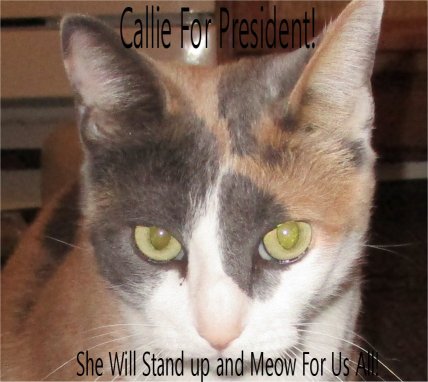
Callie Wilson has the best interest of cats everywhere foremost on her mind. Humans too, especially if they are cat owners. But she is impartial, and will welcome dog owners to the negotiating table.
A vote for Callie is a vote for a brighter future! Callie for President! Attend your caucus on Monday, Feb 1st. Thanks for viewing this political message.


- end


Monday, January 25, 2016

Getting Closer

Another day, another three flyers in the mailbox.
Ads all over the place, caucus fever pitch.
Constant reminders to support someone.
What a circus...

What gets me is all of the promises
and accusations thrown about.
When the winner does get in,
everything will go out the window.

The new president will don his
firefighters hat and try to simply maintain
our huge democracy in an insane world.
Whatever it takes to maintain the status quo,
or at least keep us from self-destruction.

Oh yes, and then to make his or her
mark on history somehow.

Promises? Those are for fools.

Late-breaking news: A billionaire
egomaniac is thinking of jumping in.
Just what we need to roil the waters.

Stay tuned ;-)

Friday, January 22, 2016

Coat of many Hatreds

Two young boys play in dirty, dusty streets. Both of their families have been forced to live in a ghetto against their will. They wear tattered clothes, with few products being available. Their meals are spotty at best. Their brethren walk around looking lost and emaciated. Every so often, a body is carted from the streets. Someone else has gained release, and final freedom from this human-created hell on earth. The boy's education is far from guaranteed, but even at their young age they have been schooled in the cruel capriciousness of human nature. Perhaps they must be conniving and sneaky to steal an extra bit of food from an unsuspecting person in their midst.

One of the boys would live in the Warsaw ghetto around 1939. He would be Jewish, forced to live there with all of the others in Poland. The death camps had not yet been constructed. His family was forced to live hand to mouth – it is a wonder many survived as long as they did. The Nazis cared little. They would have preferred them all to drop dead.

The second boy lives in present-day Gaza. He lives among the highest concentration of people in the world. His family has very few rights. If they own a car, they can only drive on certain roads. If they have land, they are most likely being encircled by Israeli settlements. If the boy gets mad and throws a rock at an Israeli soldier at one of the many checkpoints they are forced to go through, he can be detained by the Israeli military, and spend up to four years in prison. His living conditions are indistinguishable from those of the Warsaw ghetto in the late 1930's. Only his captors, the captors of all of his people, are not the inhuman Nazis, but rather the same people who had suffered so much death and despair underneath Nazi rule. The persecuted have become the persecutors.

This whole situation has complex beginnings. In 1948, the UN mandated the creation of the state of Israel. They sent the Jews to Palestine, so they could have their own land. The only problem was, Palestine was already occupied, by Jews, Muslims, and even some Christians. Sparsely occupied, but occupied, nevertheless. So when the Jewish started to arrive in large numbers, residents were displaced, and were less than happy about this. Understandable. But Israel had defined borders, and many Palestinians re-settled outside these borders, in the West Bank and Gaza. Then, there was a war in 1967. As a result of that war, Israel occupied these two territories, the West Bank and Gaza. They eventually had to pull back out. But Israel enforced heavy new restrictions on the people living there.

Sympathy for Israel and the Jewish people runs strong, especially here in the US. What they suffered at the hands of the Nazis was horrible, and they get a lot of sympathy for that, and for further aggression by Arab states. The Arabs and Persians do not want Israel around – many would like to see it eradicated. So the sympathy is understandable. But at the same time, many Palestinians have been robbed of their ancestral lands. Were they compensated, or offered compensation? If not, why not (by the UN). So their anger is also understood. But few seem to care about their plight.
The average Palestinian must wait hours at a checkpoint, if they work outside Gaza. They endure frequent harassment and harsh conditions. And yet some of them manage to hope for a better day. Their few cities in the settlements are devastated by a war-incursion in the summer of 2013. They seem to live on dust and hopes. Even getting an allotment of water is expensive and intermittent for them. If a Palestinian does build a new house, it must have a water storage tower on the roof. They never know when they will get water. What water they do get, they are charged a higher rate for than Israelis pay.

Since the Jews have been so mistreated, is is perhaps understandable they are filled with a systematic rage against the outside world. But these are not the Nazi perpetrators, they are the poor people who were living there to begin with. Still, there is historical precedent. The settlers who came to the US and displaced the natives. The Spaniards and the Indians in Mexico and South America. Various others throughout history. Stronger forces come in and displace weaker ones. Some things never change.


(Conditions in the Warsaw, Poland Ghetto in 1940)

- end


Thursday, January 21, 2016

Rolling in the Mud Again

More people running than in 2012,
Over a dozen republicans alone.
Every one promises they know
what to do about the problems we face.

It seems like they are a bunch of egomaniacs,
arrogant enough to think they can be president.
Perhaps it takes a touch of hubris to believe
one can land in the White House and take up residence.

The ads are coming thick and fast now,
my mute button is getting worn out.
They accuse each other of lying or worse,
Strutting about and flouting their clout.

Like that congressman I'm gonna kneel and pray,
That time moves fast until the big election day.
Then there will be no more ads to listen to;
regular product ads will be closer to the truth!

Questions

If we build a huge border fence, what happens when US residents want to visit Mexico?
Do we still expect a warm welcome?

If we abolish the IRS, how do we pay the national debt?
How do we pay for defense, social programs, and all of the other things we need? Donations? Bake sales? Yeah, right.

Do we just let people die wholesale, including veterans, by not funding any kind of medical care whatsoever?

What kind of society will we become? And what happens when the congressperson's own families are impacted by cutting all of the government programs. Careful where you cut there, buster, you're hurting my kids now. ??

Whoever gets in will have reality to face, Congress to deal with, and a council of advisers to deal with every day. Good luck, Mr. politician. You'll need it.

- end


Wednesday, January 20, 2016

Looking Super Today, My Friend


You can't hardly go to a movie theater nowadays without encountering another super hero movie. Once the province of comic books, superheroes have taken over modern media with a vengeance. Makes one wonder if there will ever be human capabilities approaching the fictional superpowers. Humans have already shown the miracles accomplished by our “regular” brains and hands. Should we be filling our young people's minds with superpower wish fantasies? Isn't it better to stress what can be accomplished by the use of what capabilities we have now?
There is a TV series called “Heroes” which tells the story of seemingly ordinary people who find they have extraordinary abilities. Some can fly, or move things with their hands. Others can read minds, implant thoughts, throw lightning or flames out of their hands. One can even stop time itself, freeze events, and walk through the scene to retrieve an object, or deflect a bullet, or rescue a friend from falling. If you have seen this series you know who I refer to. (I'm not stating names to protect myself against the super-lawyers.) The series is fun to watch, great escapism, and full of drama and tension. But one finds oneself thinking how nice it would be to have just one of those powers, or “abilities.”
And if a military could gain those powers, oh my. There were some episodes that touched on attempts to give troops super-powers. In real life, our troops here in the US are trained so thoroughly that they come out very capable human beings indeed. They can go without sleep, they can run fast, fight, fix things, solve problems. One could argue that their human powers have been increased to a level far above the ordinary citizen, and thus they have in effect “super powers.” But not all people come out of the military equally, especially if they have endured repeated deployments in say, Iraq or Afghanistan. Their abilities are offset by the traumas they have suffered. Some end up addicted to drink or drugs, and thus suffer a loss of even normal coping skills for day-to-day living.

But the myths endure. The “Marvel Avengers” movies draw huge crowds, and even bit-player superheros (left over from the comics) attract some interest. Perhaps this speaks to something inside us all. We wish we could do more, be stronger, faster, do better in life. This is understandable. We struggle with financial issues, relationship problems, interruptions and stress at work. The world seems like it is getting more and more complex. The rules keep changing, and we must wobble-walk ourselves through day to day hassles and problems the best we can.
But if one thinks about it, Evolution has made us into superheroes compared to our very early ancestors. Thanks to better nutrition and medical knowledge, we live twice as long, or longer, than they do. The average life expectancy up to the late 1800's was early 40's. (see http://www.infoplease.com/ipa/A0005140.html ). Now many live into their 80s and 90s. We are taller and stronger than our forebears. If you look at clothing from earlier times in museums, it looks like it was made for children. Education lasts longer. Kids now must master computers, and other technical know-how not foreseen a couple hundred years ago. Of course, now they do not need to know how to shoe a horse or attach a buggy, unless they want to as a hobby.
In the sports world, runners have long since surpassed the 4 minute mile, once thought to be impossible. Records have been set in everything from swimming and running to baseball and basketball. Many of these achievements have been reached because of technological assists and innovations. (IE wearing tight goggles to aid in swimming longer distances, or improved running shoes for marathoners. ) (see http://bmb.oxfordjournals.org/content/87/1/7.full )

One could even argue that doping and performance enhancing drugs are a form of technological advancement. Not using these substances sets athletes back onto a level playing field, but one that is a long distance behind what had been reached with the enhancers. The enhancers themselves sprang from human ingenuity and a desire to win at any cost. Are they any less valid at pushing our species forward? Probably not welcome in a sporting event, but nevertheless they still pushed us past some performance boundaries effectively.
Even though we may not feel like heroes, thanks to our technological infrastructure we live like gods. We fly thousands of miles instead of plodding twenty a day on horseback, or five on foot. We perform heart surgery and add decades to lifespans. We ride in capsules up to breach “heavens firmament” and visit our ISS outpost there. As far as a culture like ancient Egypt is concerned, we have reached “heaven” and built an earth colony there. Farfetched, but still true when you think about it. We hold in our hands a (smartphone) device to talk to anyone, most anywhere in the civilized world. We can ask a question of our device and get an answer in seconds, or minutes at most. Ancient peoples would possibly either worship us, or try to kill us out of fear.

In the “Heroes” series, and on the movies, Superheroes face moral dilemmas. Whether or not to intervene in 'normal' peoples lives and problems. Whether or not to undermine other superheroes. They judge each other, and find flaws. (Even mythological gods had flaws.) But unless they were the villain, they usually came down on the right side of things. In Guardians of the Galaxy, the main character subsumes his own personal mission, partly out of necessity, to help save the galaxy. There is usually some kind of sacrifice, even on the part of the hero. So contemporary moral values seep through. Even Hellboy, a devilish sort of hero from a different production, has a noble mission, a good side, as well as some conflicted feelings.

This mirrors human dilemmas to a large degree. We face many difficult decisions and moral quandaries. We are perhaps comforted that even Superheroes must pick their way through mental minefields and dilemmas. It reminds us we are not alone, and that our decisions affect the outcome to a large degree. We must go on fighting the good fight, no matter the mistakes that were made yesterday or last week. Wish that we may, we must make do with human powers only.

It is interesting to watch the “Heroes” people work out their problems. Hollywood writers have outlined and elucidated hypothetical problems and solutions faced by people with extraordinary abilities. A man that can read minds, renouncing any use of his ability to keep the playing field level. After faced with a pressing need, he finally relents and uses his powers. He “fell off the wagon.”
The Villain in the series actually struggles with his hunger to take powers from others, and at one point, becomes 'good.' He swears off using his power for a time, then is forced by circumstance to become evil again, to survive. A company chases down and imprisons some, then they escape. Opponents end up helping each other against a common enemy. And on and on the drama goes.

In real life, first responders, like Firemen and Policemen, are increasingly called heroes. Their occupation is certainly dangerous, and yes, they save lives, and get the bad people. But the term of Hero is thrown about quite a bit nowadays. The First Responders are compensated well for their work. To me, a true Hero is one who rises above their common station, who goes out of their way to save a life, or come to someone's aid. Now they are even calling a football bowl the “heroes bowl.” Our military members are called heroes whether they did anything heroic or not. Again, they do have a particularly dangerous job. But the title of “Hero” is one that is earned, not conferred wholesale.

Perhaps the true heroes are the common people. Those are the ones who must live with decisions by government and business leaders, and make them work. So if the government decides to implement a new parking scheme in an area of town, or raise parking meter rates, or implement snow route changes, for some imagined good outcome, it is the public who must endure.

Some thoughts on series with supernatural characters. In any show or movie, when one character has a supernatural ability, and reveals it slowly, and to maximum effect, it makes for a great show. But when you have most everyone there with some kind of ability, the effect is lessened, diminished. Everyone is throwing their weight around, and not much is being accomplished. But judicious use of powers at opportune moments to drive the plot forward can be great. There was a movie made years ago, called The Watchmen. It was about a group of heroes who administered some kind of justice on a large metropolis. They had disbanded years before. One person murdered their leader, and the rest of them reluctantly came back together to combat this new threat. It was wonderful. Mysterious, dark, suspenseful. Superhero suspense done right is a joy to behold.

But there is all kinds of material out there. The dark, twisted, conflicted hero, the anti-hero. That is the fun of watching these shows and movies – you never know what writers will come up with next. The Conventions add to the excitement. You can buy autographs of your favorite actors (in some cases), even though it may cost you two weeks pay. You can dress up, or see others dressed up, or buy toys and trinkets. It is all a marketers dream. The superhero genre may never go away.

Someday, when human beings, through technology and evolution, fly around and throw things using telekinesis, we will have to invent new, even more powerful heroes. It should be interesting to see what we come up with then.

Thanks for reading.

(1660)

For further study:


“Heroes” is a TV show produced by Tailwind Productions in association with Universal Media Studios. and aired by NBC Corp.

“The Watchmen” is a movie produced by Warner Brothers, from the graphic novel.

“Hellboy” wiki info


Tuesday, January 19, 2016

The Toughest Job - International Relations

One of the most difficult professions today has to be that of a diplomat, or ambassador. Even though time periods in the past have seemed incredibly difficult, like say, World War II, or the Vietnam Conflict era, times today are at least as difficult, if not more so. We find ourselves fighting a war on terror, but mired down in various regions of the Middle East and the Far East. Our enemies seem elusive, ghostlike. Some of them used to be co-operative, like elements of the former Iraqi army. Our enemies nowadays are religious fanatics of the worst kind, wanting to die to go to heaven, and take lots of innocents with them. To be a diplomat under these circumstances would be difficult on a good day.

There have been times in the past that have seemed dark indeed. During the days of the cold war, any incident might trigger nuclear saber-rattling on the part of the US or Soviet Union. For example, during the Yom Kippur war of 1973, there were supposedly Soviet nuclear weapons being moved towards the area of fighting between Israel and Egypt. The US went on worldwide nuclear alert, and soon, these same weapons were detected moving back where they came from. Or the time in the early 1980's , when a technology malfunction caused the US to temporarily go to high alert, only to find out it was all a mistake, not any Soviet threat. Nerves were jangled quite often in those days, and diplomats probably got many tense phone calls, or made them, to calm things down.

The hostage crisis in Iran, precipitated by the Islamic Revolution there, is another example. Some Americans managed to escape roving bands of Iranians by hiding in the Canadian embassy. The staff there helped them conjure up an escape plan, where they posed as a musical group, and assumed new identities. They made it out, with much assistance from the Canadian Embassy. Only one example of Ambassadors putting their own fingerprints on history, and averting loss of life in the bargain.

When the Soviet Union fell apart around 1991, affiliated states went off on their own. Old rivalries, quashed during the Soviet era, re-surfaced, Thus, Yugoslavia broke apart, and so did Czechoslovakia. The Baltic states fought ethnic cleansing battles. The Serbs, Croatians, and others were at each others throats. NATO finally had to step in and enforce the peace, bombing Serb tanks and positions in the process. International relations, once a black-and-white affair between the West and the Soviets, was now a multi-hued quagmire, worse than a Louisianan swamp. It seemed that the USA had more work than ever on its hands, keeping the lid on a fractured world. The war between NATO and the Serbs in the early '90's resulted in American national guard troops being stationed in Slavic lands for the first time ever.

Around this time (1990), Saddam Hussein's Iraq invaded Kuwait. The US had to send troops to expel Hussein's army, and then specialists to put out the oil fires. More work for the diplomatic corps, too. As the 1990's progressed, the US restored relations with various Soviet satellite countries who were newly independent. For example, Mongolia, Bulgaria, and even Albania. Poland became a close ally of the US. But as time went on, and the new Russian Federation strengthened under Vladimir Putin, new warning signs arose. Things were no longer going to be a cakewalk for the US. More issues arose for diplomats to sort out. 

In 1998 terrorists tried to bomb the World Trade Towers in New York. That was a wake-up call. Then-president Clinton launched some cruise missiles at their training camps in Afghanistan, then called it a day. But Al-Queda was not finished. They finally got the “job done” by crashing airplanes into the Twin Towers and the Pentagon in 2001. After that, the US entered a virtual state of war with all terrorist groups. This was a new situation. Not like a contained conflict on a certain land area, this was a continuous conflict with shadowy groups that moved around, nearly everywhere. So diplomats around the world now had a new task, that of fighting terrorism, added to their schedules. Given some of Pres. Bush's speeches, like the one where he said “either you are with us or you are against us,” the atmosphere was grim. Two years after the attacks, in 2003, we invaded Iraq, supposedly because they were seen to be supporting terrorism. 

We succeeded in unseating Saddam, only to unleash a quagmire. The three different tribal factions in Iraq (Sunnis, Shi'ites and Kurds) lost their Hussein-inflicted containment, and began fighting each other. After conquering the country, the US attempted to “train” the Iraqi army. Then we pulled most of our troops out, leaving a power vacuum. Immediately, the factions went at each other, the central government did little or could do little to prevent it. So extremist groups took to the field, and now (in 2015) we see ISIS controlling a large swath of Syria and Iraq, attempting to establish a new Caliphate or religious state. You can't establish diplomatic relations with an illegal state, founded on territory stolen away from legitimate states. Especially one that tortures or murders anyone who opposes their brand of religion. All you can do is try to contain them. Or evict them by any means from their stolen territory. Perhaps the US is to blame because of the 2003 invasion, and perhaps it is the Muslim extremists who are to blame. After all, it was them who attacked us on our soil to begin with. But in any case, international relations are being strained quite a bit by this one.

Russia's rise from a fractured state to a world power once again has been slow and steady. Vladimir Putin and his supporters have consolidated their grip on power, and established new ground rules. While Russia has a parliament, and is on the surface a democratic society, it is only skin deep. The reality is more like an autocratic, totalitarian government. But Russia has a long history of heavy-handed governments, rounding up and torturing its own people. Stalin was pretty good at this, even executing his own generals before the second world war. Nowadays, Russia is definitely a force to be reckoned with. I do not envy the diplomats who must deal with this new, assertive superpower-once-again. With thousands of nuclear weapons, millions of troops, and lots of ships and aircraft, Russia simply cannot be ignored or downplayed. But it seems that every time the US and Russia are going to play nice together, some international incident crops up to make that impossible. The latest is Turkey, a NATO member, shooting down a Russian fighter jet. The diplomats must be working overtime on that one.

But a quasi-state like ISIS or ISIL is a common enemy of all the forces involved. They would do away with all trappings of the modern society, and revert to some medieval religious dictatorship. Women would be robed and masked all the time, LGBTers just executed. Their religion would be forced on everyone, under threat of torture or death. Just when it seemed that perhaps all of the major world powers, even China, would gather forces to eliminate this scourge, some incident happens to spoil it, like the aforementioned jet being shot down. Diplomats, man your phones.

A recent event where diplomats actually lost their lives was in Benghazi, Libya a couple of years ago. A small staff was manning a US Consulate there, headed by a popular, affable FSA. Suddenly there was an attack, and everyone inside was killed. At first it was said that a mob had stormed the facility. But later it came out that the attack was planned, coordinated by a branch of Al-Queda. There was a lot of finger pointing, including blame placed on then secretary-of-state Hillary Clinton. Funding requests for more embassy guards in the past were turned down by Congress. Nevertheless, some of those same fossilized congressmen blamed Clinton. In any case, it was a terrible tragedy, illustrating just how risky it can be to be an international diplomat. 

The unrest and fighting in Libya stemmed from the overthrow of Mumahdar Gaddafi, the then-strongman leader. While his overthrow was seen as a positive at first, all of the factions fighting each other soon became a problem. Oil exports shrank, and societal structures broke down. And religious extremists moved in to fill a power vaccuum. The movement to unseat Gaddafi stemmed in part from the “Arab Spring” uprisings in Egypt. People took to the streets to overthrow a long-established corrupt government there. These successes spawned copycat movements in other states, including Libya. Diplomats all over the region must have been spending a lot of sleepless nights reporting on events and occurrences. Not to mention trying to protect American citizens and/or interests in the region. International relations put to the test. Who do we talk to that is in power now, when power is changing hands so fast. A democratically-elected government in Egypt with the Muslim Brotherhood as the majority was quashed by the military almost immediately after it was elected. The Muslim Brotherhood was disbanded by edict. And a new government was put in place. Some democracies are better than others, I guess. The US was put in the position of dealing with various governments in Egypt, in rapid succession!

Pakistan is another touchy example. There is basically a military dictatorship there (could be wrong). There are human rights violations, there is a state-sponsored terror organization to undertake battles in the Punjab, a region contested over with India. Pakistan also has a nuclear arsenal. We have diplomatic relations with both India and Pakistan, and must get along with both, even though they hate each other, and have fought several wars. After many years of hunting, the US finally found Osama Bin Laden, the head of Al-Queda. He was living in a comfortable villa in Pakistan. The Paks knew we wanted his head badly. They have intelligence apparatuses, they are not dumb. And yet they claimed ignorance. But, we have to get along – easier than fighting yet another war with someone. Diplomats, take your vitamins.

Every time I think we surely live in the most complicated age of international relations ever, something else happens to add to the complexity. Today's terror miasma makes the post WWII world look downright simplistic. It even makes the world wars look simple by comparison. Thank goodness we have a lot of computers to help us figure things out, otherwise we would be completely lost. The International diplomatic corps has to really be nimble on their feet to stay on top of things, and keep relations on a positive course. Here is hoping they succeed, and keep our world from self-destructing. Thanks for reading. 

 - end


Unreality in the Air

  So many things are off kilter; Mass European navies headed to the Strait of Hormuz, while Iranians are sinking cargo ships. Trump is de...